Can IoT reduce energy consumption in buildings?

In the EU, the goal is to reduce greenhouse gas emissions by at least 55% by 2030. Buildings significantly contribute to greenhouse gas emissions, as almost 75% of the EU’s building stock is currently energy inefficient. In an inefficient building, much energy is wasted; it goes up in smoke. The figure is also high globally, …

board-member-certificate

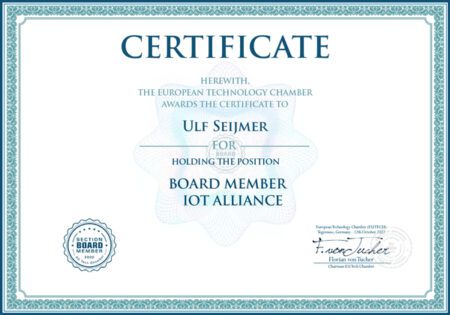
Eutech IoT Alliance Board Member

Great news, I am now a part of the IoT Alliance of Eutech as a board member. Eutech, The European Technology Chamber, is a non-profit organization on a mission to enable European businesses to use technology to benefit Europe and humanity. Eutechs core value and vision is Technology Obliges. EUTECH is committed to bringing people …

NB-IoT part 4: different implementations

NB-IoT can be implemented in three ways: standalone, guard band and in-band. NB-IoT standalone operation Standalone: NB-IoT channel used outside the 4G/5G spectrum, for example, the spectrum used for GSM or satellite communications. Standalone operation is when NB-IoT is used exclusively within a spectrum, whether in a private or public network. This model provides the …

NB-IoT repetitions

NB-IoT part 3: repetitions

NB-IoT is designed to achieve a 20 dB coverage improvement over GSM’s MCL or link budget. The maximum link loss, MCL, for GSM is 144 dB. The maximum link loss for NB-IoT is, therefore, 164 dB. There are several ways that NB-IoT improved the signal over GSM. NB-IoT and Message repetition The downlink improvement is …

NB-IoT basics: part 2 power saving

For NB-IoT, the general design goal of the 3GPP standard is that the battery should last for at least ten years. NB-IoT reduces power consumption using mechanisms called eDRX and PSM. The eDRX (extended Discontinuous Reception) and PSM (Power Saving Mode) parameters allow the device to go into a deep sleep mode for a few …

NB-IoT versions

NB-IoT basics: part 1 versions

NB-IoT is one of two 5G LPWAN standards (the other is called LTE CAT-M1). NB-IoT and LTE-M have excellent energy consumption and power-saving features; they are great for saving a lot of energy compared to other cellular standards. There are different technologies and functions within each of these two to do that. If you have …